In the past, the first question a physical store needed to answer was relatively simple:
How do I let people know what kind of business I am?
That is why storefront signs, illuminated signs, light boxes, printed graphics, posters, and window displays became such an important part of commercial spaces. Their job was straightforward—to tell people the store name, brand, and what the business offered.
But things have changed.
A restaurant may have three or four competitors on the same street. A shopping area may have a dozen coffee shops competing for attention. Before entering a store, consumers may already have seen dozens or even hundreds of pieces of commercial content on Instagram, TikTok, YouTube, Google Maps, or other digital platforms.
Consumers are not short of information.
They are surrounded by too much of it.
What is becoming increasingly scarce is attention.
This is why digitalization in physical retail cannot only be discussed in terms of payment systems, online stores, CRM platforms, or social media. Another important change is taking place, and it is easy to overlook:
The physical store itself is gradually becoming a visual medium capable of continuously updating and delivering content.
Traditional signage answers:
“Who are we?”
Digital display technology can go further:
“Who are we, what do we sell, what do we have today, and why should you stop and take a look?”
That is the real reason why full-color LED displays are becoming worth serious consideration in small and medium-sized commercial environments.
1. Why Physical Stores Increasingly Need Dynamic Visual Content
If we go back ten or fifteen years, a restaurant could produce an attractive light box advertisement and use it for six months or even longer.
At that time, consumers had fewer channels through which they encountered commercial information. Storefronts, outdoor advertising, television, newspapers, flyers, and other traditional media still played a major role in communication.
Today, consumers are accustomed to a very different information rhythm.
They open their phones and see constantly changing short-form videos.
They scroll through social media and encounter a continuous stream of images and videos.
They browse e-commerce platforms and watch products being demonstrated dynamically.
They search for a brand and may encounter videos, images, reviews, and user-generated content before they ever visit the physical location.
This does not mean consumers have stopped looking at static content.
Static images, signs, posters, and storefront graphics still work.
The real change is that dynamic visual content has become a familiar way for consumers to receive information.
So when a consumer walks down a street, they are not entering an information vacuum.
They may have just watched a fifteen-second video on their phone. Then they look up and see a restaurant.
If that restaurant only has a traditional static sign, there is nothing inherently wrong with it. But the amount of information it can communicate is limited:
“This is a restaurant.”
A digital display can communicate much more:
“Here is our signature dish.”
“Here is today’s special offer.”
“Here is our new product.”
“Here is what we are promoting this week.”
It can even show a short video of the food being prepared.
The difference is not simply about whether one sign is brighter than another.
It is about how information is communicated.
A storefront can move from being a fixed information carrier to becoming a visual communication channel with continuously changing content.
2. From Static Signs to Digital Displays: How Commercial Communication Is Changing
Why have traditional signs remained effective for so long?
Because they have several obvious advantages:
They are stable, durable, relatively affordable, and simple to maintain.
A well-made storefront sign can remain in place for years.
For information that rarely changes—such as a brand name, logo, or business category—a static sign is still an excellent solution.
The problem appears when the information itself changes frequently.
Imagine a pizza restaurant launching a new product.
With a traditional light box, the process usually involves creating new artwork, producing it, printing it, and replacing the existing graphic.
Next month, there is a special promotion.
Another design needs to be produced.
Christmas arrives.
Another one.
Summer begins.
Another one.
The basic logic of traditional advertising is therefore:
Produce once, use for a period of time.
Digital display technology changes that logic:
Install once, continuously update the content.
This is one of the most important aspects of LED digital signage.
A full-color LED display is not simply “a light box that can glow.”
It is closer to a small digital content platform.
The same display can show:
- Product images
- Promotional videos
- GIF animations
- Brand content
- Pricing information
- Special offers
- Seasonal campaigns
- New product launches
- Service information
- Store announcements
The merchant is no longer purchasing a single fixed advertisement.
They are gaining a visual space that can be continuously redefined.
Of course, this does not mean a commercial LED display is automatically better than a traditional light box.
If a business only needs to display its name, logo, and opening hours, a well-designed static sign may already be sufficient.
Digital signage becomes more valuable when:
content changes frequently, products need ongoing promotion, campaigns are regularly updated, or the business wants stronger visual communication.
That distinction is important when evaluating LED displays for storefront marketing.
3. What Does Full-Color LED Display Technology Actually Change?
From a technical perspective, LED display technology is not mysterious.
At its basic level, an LED display uses large numbers of light-emitting diodes to form pixels. Red, green, and blue components are combined at different intensities to produce a wide range of colors.
This is the basic RGB principle behind full-color LED displays.
For most business owners, however, understanding the internal electronics is less important than understanding the specifications that directly affect real-world performance.
Pixel Pitch: Smaller Does Not Always Mean Better
Pixel pitch refers to the distance between the centers of adjacent pixels and is normally expressed using a “P” value, such as P2.5, P3, or P5.
Generally speaking, a smaller pixel pitch means a higher pixel density and greater image detail when viewed from relatively close distances.
But this is where a common misunderstanding appears:
A smaller pixel pitch does not automatically mean it is the right choice for every application.
If a storefront LED display is installed outside a shop and most viewers stand five or ten meters away, paying significantly more for extremely fine pixel density may not provide meaningful practical benefits.
On the other hand, if the display is installed inside a store, in a window, or in a location where customers can stand very close to it, a smaller pixel pitch may become more important.
The professional way to approach the decision is therefore:
Determine the typical viewing distance first, then consider pixel pitch.
In other words, instead of asking:
“Is P2.5 better than P5?”
A more useful question is:
“Where will customers actually be standing when they look at this display?”
Brightness: Indoor and Outdoor Applications Are Different
Brightness is another important specification, commonly expressed in nits.
For outdoor LED advertising screens, ambient light must be taken seriously.
Under direct sunlight, a display with insufficient brightness may struggle to maintain good visibility.
But brightness is not simply a case of “higher is always better.”
A very bright display installed indoors, where the surrounding environment is relatively dark, may be unnecessary and can even become uncomfortable to view.
Brightness is therefore fundamentally a question of environmental matching.
Outdoor storefronts, shop windows, indoor spaces, and semi-outdoor environments may all require different display solutions.
Refresh Rate: Important for Both Viewing and Camera Recording
Refresh rate is another specification worth considering, particularly if the LED screen will be photographed or recorded with smartphones and cameras.
An unsuitable refresh rate can cause visible scanning, flickering, or instability when the display is captured on camera.
This is becoming increasingly relevant to storefront marketing.
A customer may photograph the shop.
They may record a video.
They may post the storefront on social media.
Therefore, a modern storefront display is not only being viewed by human eyes.
It may also become part of someone else’s digital content.
The question is no longer simply:
“Does the screen look good?”
It can also be:
“Does the screen look good when someone records it with a phone?”
That is one of the interesting differences between digital LED displays and traditional illuminated signage.
IP Rating: More Than a Simple “Waterproof” Label
Outdoor LED displays often use protection ratings such as IP65.
The IP code is defined under IEC 60529 and describes the degree of protection provided by an enclosure against external factors such as solid objects and water.
For business owners, however, IP65 should not simply be interpreted as:
“This product can survive anything outdoors.”
A better interpretation is:
The enclosure provides a specified level of protection, while the overall installation still needs to consider structure, connections, cable routing, drainage, installation direction, and long-term environmental exposure.
Technical specifications only become meaningful when they are considered within the actual application.
4. Why the Shape of a Display Is Becoming Part of Commercial Communication
Most traditional LED displays are rectangular.
There are practical reasons for this.
Rectangular displays match conventional video formats, standard content layouts, and modular manufacturing systems.
But when LED display technology moves into retail stores, restaurants, cafés, beauty salons, clothing stores, and other commercial environments, the question changes.
The business is no longer asking only:
“What should I display?”
It also starts asking:
“What should the display itself look like?”
This is because the display becomes part of the store’s visual design.
What shape is the wall?
What does the storefront look like?
What shape is the logo?
How is the window arranged?
Does the brand want to communicate technology, youth, creativity, tradition, or premium quality?
These factors can all influence the form of a commercial LED display.
This is where the round LED display becomes particularly interesting.
5. Round LED Displays: From Display Hardware to Visual Identity
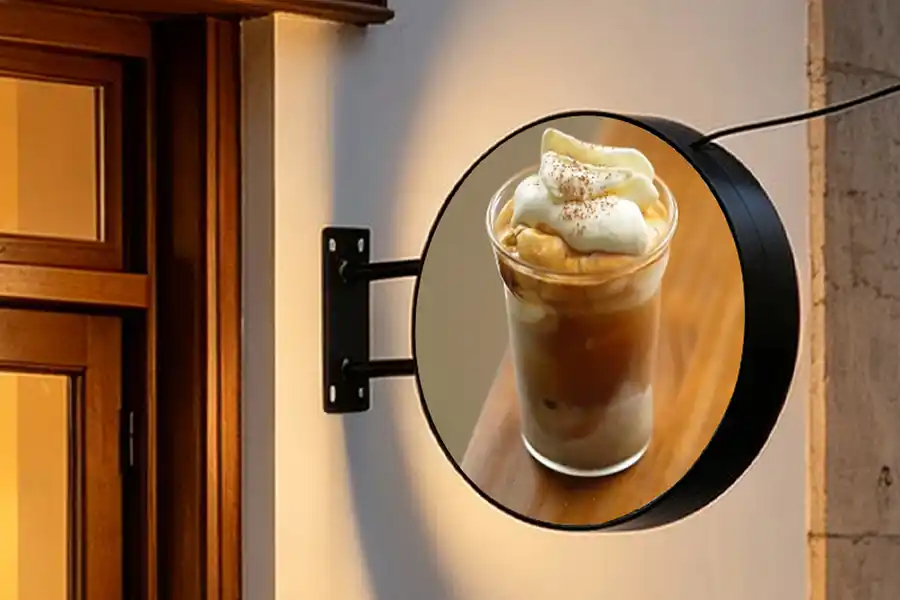
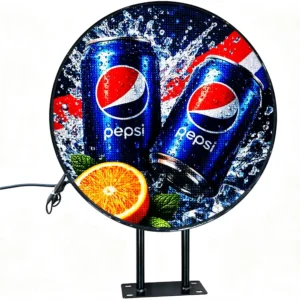
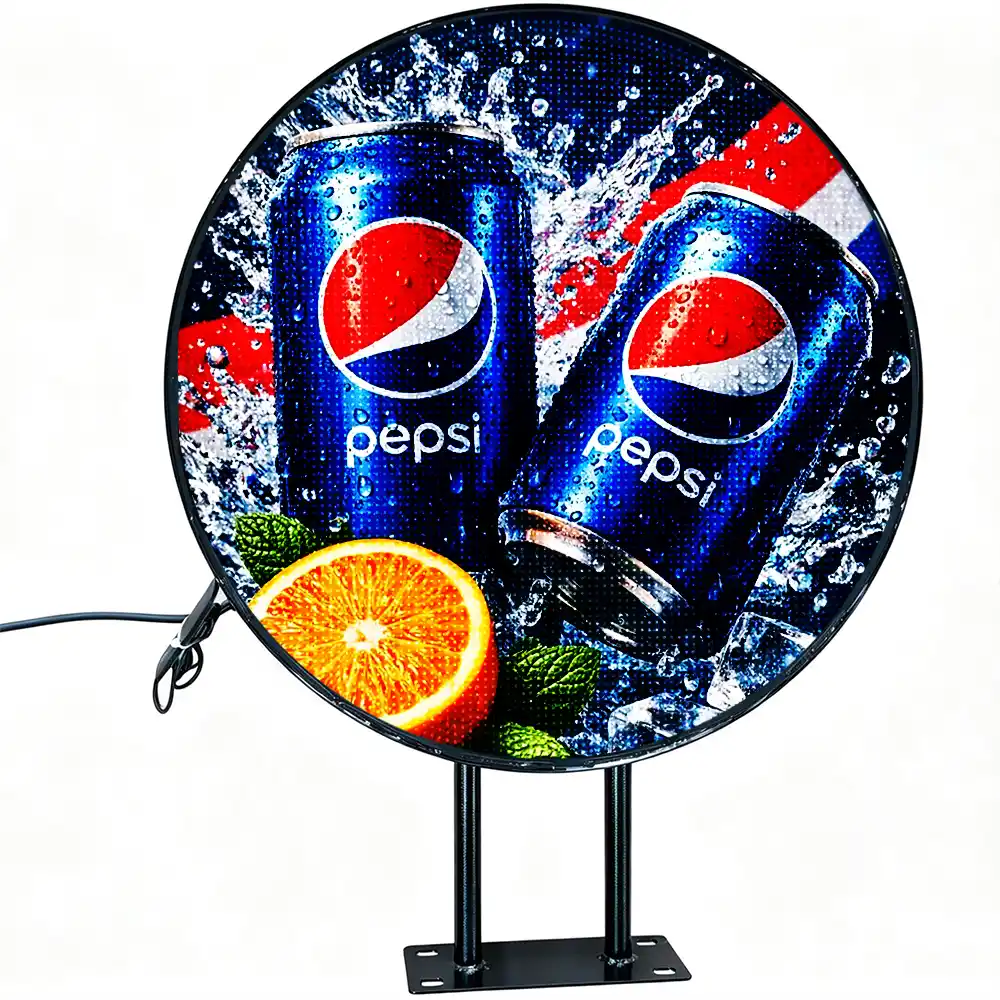
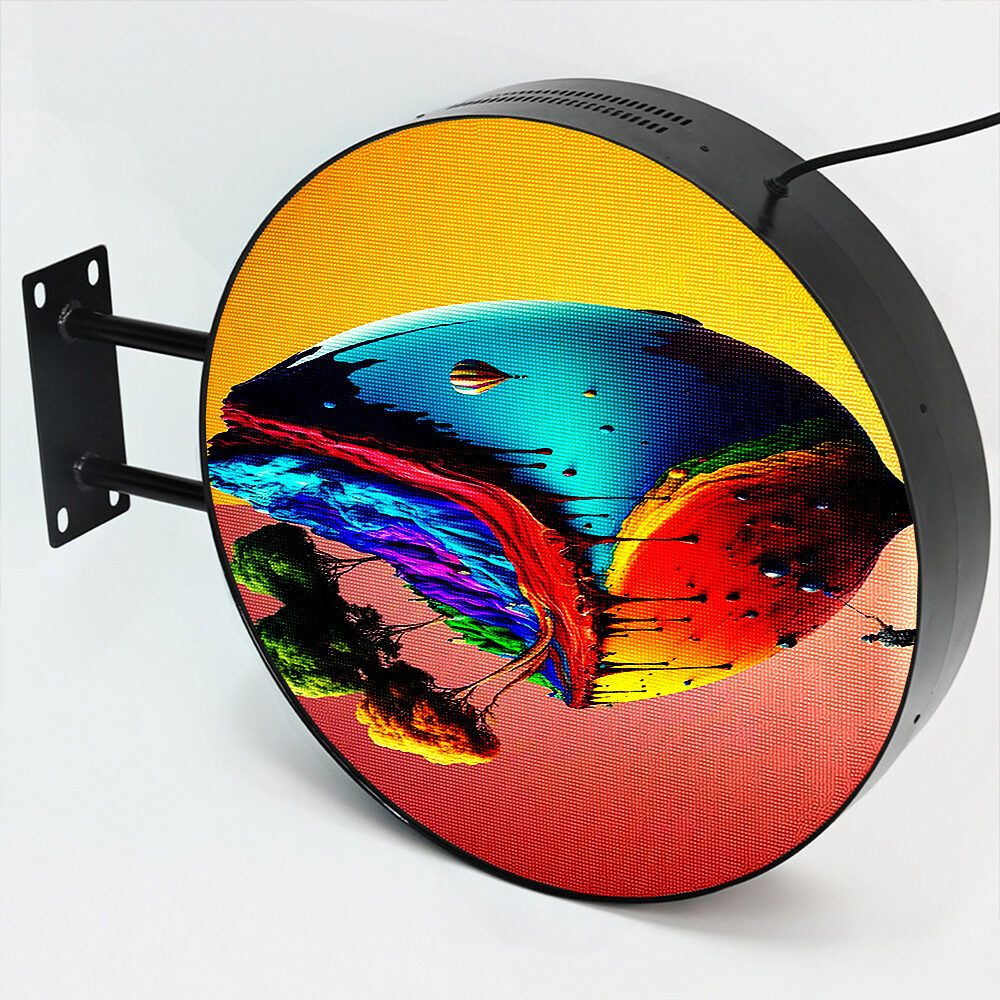
The biggest advantage of a round LED display is not that its technical specifications are automatically superior to those of a rectangular display.
Its more obvious difference is visual:
It changes the way people recognize and process the display within the surrounding environment.
We see rectangles everywhere.
Phones are rectangular.
Televisions are rectangular.
Computers are rectangular.
Most advertising screens are rectangular.
Therefore, when a round full-color LED screen appears in a storefront, it naturally creates a visual contrast with the surrounding information environment.
That contrast does not automatically make it better.
But it can make the display more distinctive.
For businesses that want to strengthen brand identity and create a more memorable storefront, that difference can be valuable.
A coffee shop could use a round LED display to build visual content around its logo, coffee products, or brand identity.
A beauty business could use a circular LED screen as a visual focal point for people, products, or dynamic branding.
A clothing store could use it as part of the storefront design rather than treating it simply as another advertising board.
A restaurant could use it to highlight signature dishes or special campaigns.
Round LED displays can be particularly effective in environments that emphasize:
visual identity, creative expression, brand recognition, and spatial design.
However, round displays also have limitations.
The most obvious one is:
Content cannot simply be taken from a standard rectangular video and dropped onto a circular canvas without thought.
The usable visual area is different.
Text placement, logo proportions, subject positioning, and video composition all need to be reconsidered.
If the content has not been designed for the circular format, even excellent hardware may not deliver an excellent result.
So a round LED display is not only a hardware decision.
It is also a content-design decision.
6. Square and Rectangular Full-Color LED Displays: Efficient Information Carriers
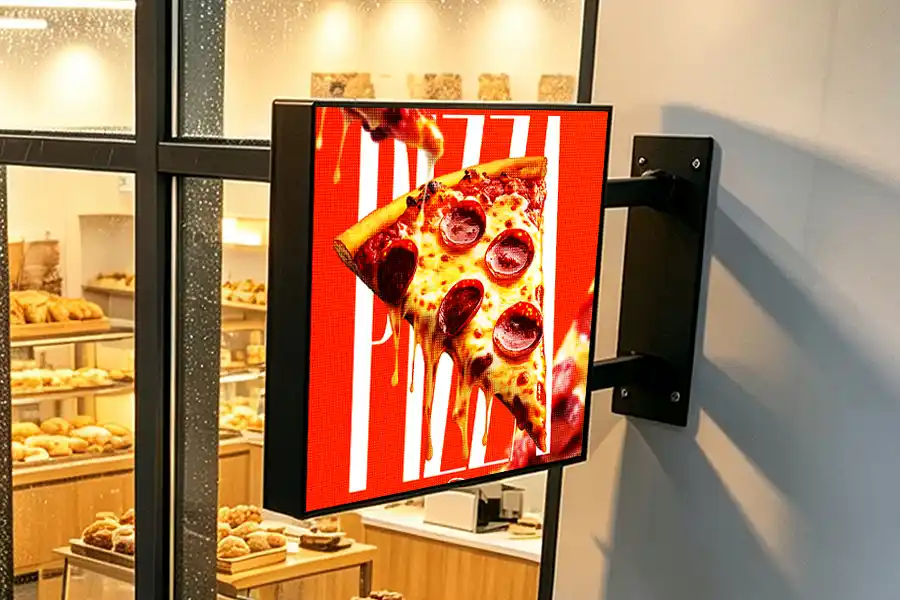
If round LED displays place more emphasis on visual identity, square and rectangular LED displays generally place more emphasis on:
information capacity and content compatibility.
That is one of their strongest advantages.
Most commercial videos, product images, promotional graphics, and advertising materials are already designed in rectangular formats.
As a result, square or rectangular LED displays are often easier to integrate into existing content workflows.
For a restaurant, a rectangular LED advertising screen can display multiple products.
For a clothing store, it can play fashion videos and model presentations.
For a retail business, it can display product images, pricing, and promotional offers.
For an advertising company, standard client content is usually easier to adapt to a rectangular digital display.
This does not mean rectangular LED displays have become less important because round LED products exist.
Quite the opposite.
If a business needs to display:
- Menus
- Product images
- Prices
- Service information
- Promotional offers
- Horizontal videos
- Brand presentations
then a rectangular display is often the more efficient choice.
A simple way to describe the difference is:
Round LED displays tend to emphasize visual identity, creative presentation, and brand memorability.
Square and rectangular LED displays tend to emphasize information capacity, product presentation, and content compatibility.
But these are selection principles, not absolute rules.
The right choice still depends on the store layout, viewing distance, content, brand positioning, and budget.
7. Why Small and Medium-Sized Businesses Should Pay Attention to Digital Displays
This may be the most important part of the discussion.
Large brands have many marketing options.
They can buy shopping-mall advertising space.
They can invest in outdoor media.
They can run large digital advertising campaigns.
They can organize major brand events.
But a typical restaurant, barber shop, café, clothing store, or independent retailer cannot necessarily operate with the same marketing budget.
What these businesses need is often something much more practical:
A relatively compact, manageable, long-term digital marketing tool that can be updated continuously and directly support day-to-day storefront marketing.
This is where a storefront LED display becomes interesting.
Imagine a Kebab shop with a conventional light box outside.
It displays one meal deal today.
Tomorrow, it displays the same meal deal.
A month later, the same promotion may still be there.
With a digital display, the business could show breakfast offers in the morning, lunch promotions during the day, drinks in the afternoon, and signature products in the evening.
When a seasonal campaign starts, the content can change.
When a new product launches, the display can change.
When a promotion ends, it can be removed.
The storefront wall, window, or entrance is no longer simply physical space.
It begins to acquire a certain media function.
That leads to an important idea:
Turn the storefront itself into a small digital media channel.
8. How Different Industries Can Use Round and Square LED Displays
Restaurants: Turning Products from Words into Visual Experiences
Restaurants are one of the easiest sectors in which to understand the value of digital displays.
Imagine two situations.
The first storefront says:
Burger — £8.99
The customer understands that the restaurant sells burgers.
The second storefront plays a short video showing a burger being prepared: the bun, beef, cheese, sauce, and finished product appear dynamically alongside the promotion.
The second approach does not guarantee higher sales.
But it communicates much more visual information.
This is particularly relevant to businesses such as:
- Burger restaurants
- Pizza shops
- Kebab shops
- Chinese restaurants
- Cafés
- Bubble tea stores
- Bakeries
These businesses often sell products that are naturally visual.
A digital advertising screen can display:
- Signature products
- New products
- Meal deals
- Limited-time promotions
- Preparation videos
- Seasonal campaigns
- Popular dishes
There is, however, one important principle:
Do not turn the LED screen into an endlessly scrolling menu.
If there is too much text, the text is too small, or the content changes too quickly, customers may remember nothing.
Good digital storefront content should allow a viewer to understand one clear message within a short period.
Beauty and Hair: The Transformation Is the Product
Beauty salons and hair businesses are particularly suitable for dynamic visual content.
Customers are often not purchasing an abstract “service.”
They are purchasing:
the result after the service.
That makes visual transformation extremely powerful.
A display can show:
Before and After,
hair transformations,
beauty treatments,
service processes,
store environments,
and seasonal promotions.
A round LED display can serve as a visual focal point, while a square or rectangular screen can carry more detailed service information.
Fashion Retail: Turning the Window into Dynamic Content
Fashion businesses have always relied heavily on window displays.
But traditional window displays have one major limitation:
changing them can require physical work and new materials.
With digital signage, a storefront can show:
new collections,
model styling,
seasonal fashion,
brand stories,
promotional campaigns,
and short-form videos.
The storefront window is no longer simply a place where several garments are displayed.
It can become a continuously changing brand-content window.
Jewellery, Eyewear and Watches: Products That Depend on Visual Quality
These industries rely heavily on visual presentation.
Material, reflections, details, wearing effects, and brand atmosphere are difficult to communicate through a sentence of text.
A high-definition full-color LED display can act as a kind of visual amplifier.
Of course, this does not mean a screen can replace the physical product.
Customers still need to see the actual product, compare options, consider pricing, and interact with staff.
The role of the display is to begin that visual communication before the customer even walks through the door.
Pharmacies, Health and Beauty Businesses
These businesses can use digital displays to communicate:
service information,
opening hours,
brand content,
product categories,
and compliant health-related information.
However, there is an important responsibility here:
The more powerful the communication technology becomes, the more important content management becomes.
Healthcare-related content must be accurate and compliant.
A digital LED advertising screen should never be used to exaggerate unverified medical benefits or make unsupported claims.
Technology can improve communication efficiency.
It does not remove the responsibility of the business to ensure that its content is accurate and appropriate.
9. For Advertising Companies, LED Digital Signage Can Also Create New Business Opportunities
If we look at LED digital signage only from the perspective of the end customer, it is easy to underestimate its commercial potential.
For advertising agencies, sign makers, and signage companies, it can also become a new product and service category.
Traditionally, an advertising company might provide:
design,
printing,
light boxes,
storefront signs,
installation.
The business model can potentially evolve toward:
Hardware + Content + Installation + Content Updates + Maintenance
For example, an advertising company may install a digital LED display for a restaurant.
The relationship does not necessarily have to end when the installation is complete.
The agency could continue to provide:
monthly promotional content,
seasonal designs,
new-product advertising,
technical maintenance,
and remote content management.
A one-time signage project can therefore potentially develop into an ongoing service relationship.
This is one of the more interesting aspects of digitalization:
It does not only change the product. It can also change the service provider’s business model.
10. How Should You Choose Between a Round and Square LED Display?
If I were advising a business owner, I would not start by asking:
“Do you want a round display or a square display?”
I would start with eight questions.
First: What Is the Viewing Distance?
Will customers be standing one to three meters away?
Or will they be viewing the display from across the street?
Different viewing distances can lead to different pixel-pitch requirements.
Second: Where Will It Be Installed?
Will it be mounted on:
the storefront,
a wall,
a window,
a column,
or inside the store?
The location influences both the appropriate size and shape.
Third: What Type of Content Will Be Shown?
If the main purpose is to play standard product videos and advertising content, a rectangular screen is often easier to work with.
If the content is heavily focused on logos, brand visuals, and creative presentation, a round LED display may offer stronger visual differentiation.
Fourth: What Is the Brand Positioning?
Creative and visually driven brands may benefit from distinctive display shapes.
Businesses that prioritize information efficiency and product presentation may prefer rectangular formats.
Fifth: Indoor or Outdoor?
Outdoor applications require greater attention to brightness, environmental protection, installation structure, and long-term reliability.
Sixth: How Much Text Needs to Be Displayed?
If the display needs to communicate menus, prices, services, and other detailed information, a rectangular screen usually provides more efficient use of the display area.
Seventh: What Is the Budget?
Do not compare only the screen price.
Consider installation, content creation, maintenance, transportation, and long-term operating costs as well.
Eighth: How Frequently Will Content Change?
If a business plans to display one fixed piece of content for an entire year, the advantages of digital signage may not be fully utilized.
If the business regularly launches promotions, new products, and seasonal campaigns, the value of a digital display becomes much more apparent.
A Practical Comparison
| Selection Factor | Round Full-Color LED Display | Square / Rectangular LED Display |
|---|---|---|
| Visual differentiation | Strong | Moderate |
| Creative presentation | Strong | Strong |
| Content compatibility | Requires tailored design | Easier to adapt |
| Product presentation | Suitable | Excellent |
| Brand presentation | Excellent | Suitable |
| Information capacity | Moderate | Strong |
| Decorative value | Strong | Moderate |
| Standard advertising content | Requires composition adjustments | Easier to adapt |
| Visual focal-point potential | Strong | Depends on size and design |
| Suitable applications | Creative stores, brand displays, visual focal points | Restaurants, retail, promotions, product presentation |
So the professional answer is not:
“Which one is better, round or square?”
It is:
“Which shape is better suited to your space and your content?”
11. How AI, Short-Form Video and Digital Content Will Change Storefront LED Advertising
This may be one of the most important developments to watch over the next few years.
In the past, creating a professional commercial video often required photographers, designers, and video editors.
For a small restaurant, this could represent a significant cost.
Today, AI image generation, AI video tools, automated editing, and template-based design are steadily reducing the barrier to producing basic marketing content.
This does not mean AI will immediately replace professional designers.
The more realistic change is much simpler:
Tasks that previously required a professional production team are becoming increasingly accessible to small businesses.
A coffee shop may be able to quickly create promotional content for a new drink.
A restaurant can turn product photos into dynamic advertising content.
A clothing store can create seasonal visual campaigns.
A beauty salon can create promotional content for specific services.
These materials can then be distributed through:
Instagram,
TikTok,
YouTube,
Facebook,
and the store’s own LED digital signage.
This creates an interesting loop:
Social media generates content → content enters the physical store → the store generates new visual material → that material returns to social media.
The boundary between physical and digital commerce becomes increasingly blurred.
12. Technology Is Not the Goal. Business Results Are.
There is a common mistake in the LED industry.
People can become too focused on specifications.
What is the pixel pitch?
How many nits?
What is the refresh rate?
What is the IP rating?
What is the resolution?
All of these questions matter.
But from the perspective of a restaurant owner, they should ultimately lead back to a much simpler question:
“What business problem does this solve for me?”
A business does not buy an LED display simply to own an LED display.
The real objectives may be:
To help more people notice the store.
To help customers understand what the business sells more quickly.
To highlight key products.
To strengthen storefront visual identity.
To improve brand presentation.
To communicate promotions more efficiently.
To make limited physical space perform more marketing functions.
That is why it is not professional to say:
“Install an LED screen and your sales will increase by a specific percentage.”
Such claims are difficult to verify and depend on far too many variables.
A good display cannot fix a poor product, an uncompetitive price, a bad location, poor service, or weak business management.
What LED digital signage can realistically improve is:
information presentation, visual attention, content flexibility, and communication efficiency.
The final business result still depends on the product, pricing, location, service, content quality, and overall operation of the business.
That is the more objective way to look at it.
13. The Real Value of an LED Display Is Not Simply “Brighter and Clearer”
If we look several years ahead, one important change is likely to become increasingly obvious:
LED displays will become less like traditional “advertising boards.”
In the past, purchasing an advertising board meant purchasing a physical carrier for a message.
Today, purchasing a digital display can mean purchasing:
Hardware + Content + Update Capability + Visual Communication Capability.
Therefore, a business should not only ask:
“How much does this LED display cost?”
It should also ask:
Can I update the content easily?
Who will manage it?
Can I change campaigns quickly?
How easy is it to create new content?
How will it be maintained?
How long can it realistically be used?
Will adding new content later be difficult?
Once these questions are considered, an LED display becomes more than a hardware product.
It starts to resemble a piece of digital marketing infrastructure for the storefront.
This is why round LED displays and square or rectangular full-color LED displays deserve to be considered within the broader context of physical-store digitalization.
14. The Store of the Future May Become a Digital Media Channel Itself
In the past, a store needed a sign to tell customers:
“Who are we?”
Later, stores needed light boxes and posters to communicate:
“What do we sell?”
Today, digital content is giving physical stores another capability:
“What do we have right now, and why should you stop and take a look?”
This does not mean traditional signs, light boxes, or static advertising will disappear.
They still have their own value.
What is changing is that physical businesses now have more choices.
A round full-color LED display is not designed to replace every rectangular advertising solution. Its strength lies more in visual differentiation, creative presentation, and brand recognition.
Square and rectangular full-color LED displays are not simply replacements for traditional signs. They are particularly effective for information delivery, product presentation, and conventional digital advertising content.
For small and medium-sized businesses, however, the more important question may no longer be:
“Should I buy an LED display?”
It may be:
“Does my store have a digital visual entry point that can continuously create, update, and communicate content to potential customers?”
These two questions may look similar, but they represent completely different ways of thinking.
The first is about buying equipment.
The second is about building marketing capability.
And that may be the more important part of modern commercial digitalization.
Technology is not ultimately about giving businesses increasingly complicated equipment.
Its real purpose should be much simpler:
To give limited commercial spaces more efficient, flexible, and continuous communication capabilities.
When a wall, storefront, window, or entrance can continuously change, update, and communicate content like a media channel, a physical store becomes more than just a place where products are sold.
It becomes another content node within the digital commercial ecosystem.