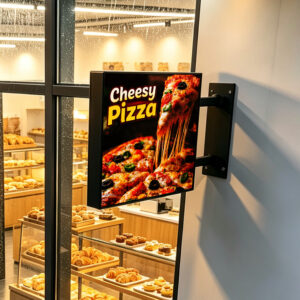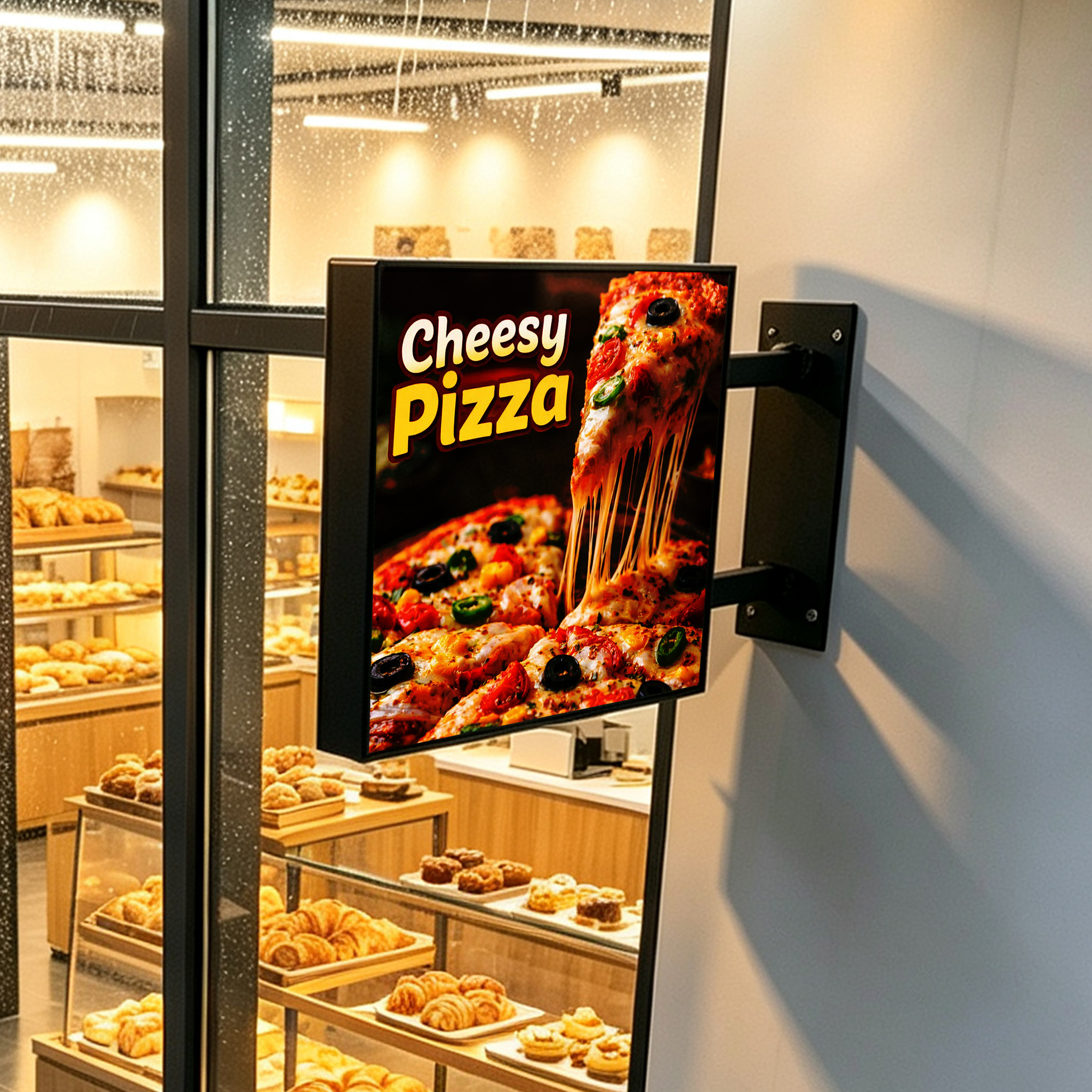
In the past, many shop owners chose acrylic light boxes for their storefront signs. The concept was simple: LED lights were installed inside, with a fixed printed graphic on the outside. Once illuminated at night, the shop name, logo or brand could be seen from a distance.
It was a relatively simple and cost-effective solution, and it could last for years.
But there is one obvious limitation: the content is fixed.
If a shop launches a new product, changes its prices or wants to promote a special offer, the printed graphic usually has to be redesigned and replaced. That means extra production work, installation and time.
This is one of the reasons more businesses are now considering a LED screen for shop applications.
A full-colour LED video light box can be thought of as a traditional light box with a digital display built into it. Instead of showing one permanent image, it can display pictures, videos, animations, promotions and other changing content.
For shops that rely on regular promotions and visual advertising, this flexibility can make a significant difference.
1. What Is the Difference Between an Acrylic Light Box and an LED Video Light Box?
The basic difference is quite simple.
Traditional acrylic light box:
One fixed graphic + LED lighting.
LED video light box:
Thousands of individually controlled LED pixels forming a digital display.
Acrylic light boxes can still be a practical choice when a business only needs to display its name, logo, brand colours or other information that rarely changes.
However, an LED display screen for shop use becomes more useful when the content needs to change regularly.
For example:
- A bubble tea shop can promote new drinks, seasonal products and “2 for 1” offers.
- A restaurant can display different content for breakfast, lunch and dinner.
- A clothing store can show new arrivals, seasonal discounts and model videos.
- A beauty salon can promote treatments, packages and special events.
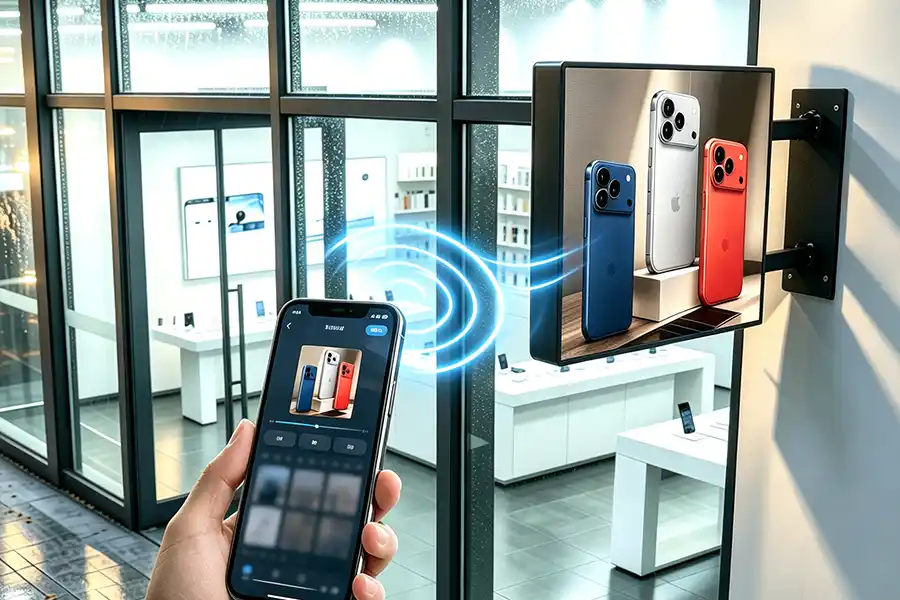
- A mobile phone shop can advertise new devices, payment plans and promotions.
- A chain business can update advertising content across multiple locations.
If a shop plans to display exactly the same message for several years, a traditional light box may be the simpler option.
But if promotions change every week—or even every day—the flexibility of an LED screen display for shop advertising can become much more valuable.
2. Square or Round LED Screen: Which One Should You Choose?
There is no universal answer. The right shape depends on how the screen will be used.
Square LED Screen: Practical and Easy to Design
A square LED screen for shop front applications is suitable for many different types of businesses.
The rectangular display area makes it easier to include:
- Shop names
- Logos
- Product images
- Prices
- Discounts
- Opening hours
- Promotional messages
- QR codes
Square screens are often suitable for locations such as:
- The side of a shop front
- Shopping centre entrances
- Glass shop windows
- Areas beside the checkout
- Shopping centre corridors
- Store corners
If the main purpose is to combine branding with promotions and product information, a square screen is usually easier to design and manage.
It can work particularly well as an LED advertising screen for shop promotions because the available display area is easy to divide between images, text and offers.
Round LED Screen: More Distinctive and Brand-Focused
A round LED screen creates a different visual impression.
It can work particularly well for:
- Coffee shops
- Bubble tea shops
- Beauty salons
- Barbers
- Fashion stores
- Trendy retail stores
- Small street-front businesses
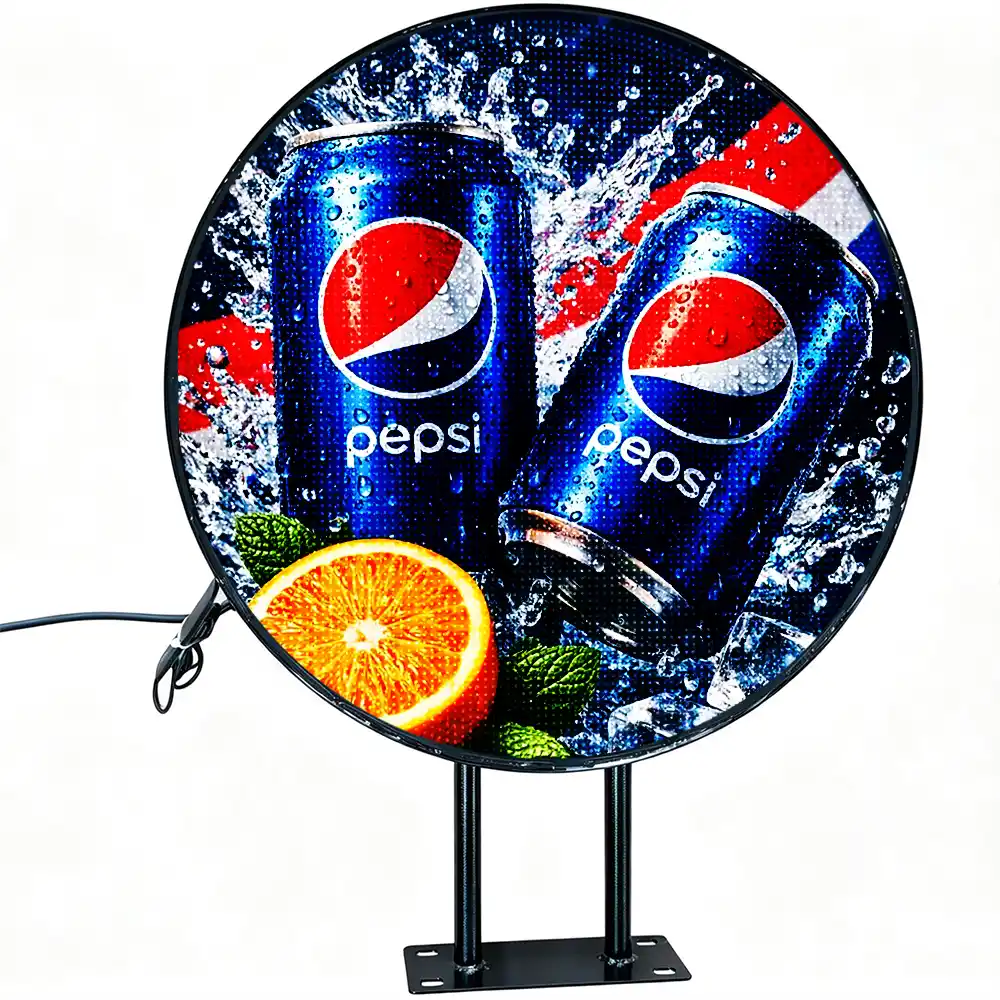
A round Led screen sign can function almost like a large illuminated brand logo.
When installed perpendicular to the storefront, it can also work as a projecting sign, allowing people approaching from the side to see the business.
Round LED screens are particularly suitable for:
- Brand logos
- Short words such as “Coffee” or “Open”
- Product icons
- Simple animations
- One main product
- Short promotional messages
However, a round screen is not ideal for simply putting a standard landscape advertisement into a circular frame. The corners of the image are wasted, and long text placed near the edges can become difficult to read.
For this reason, round screens generally work better with less text, larger graphics and stronger visual recognition.
If the main purpose is displaying prices, menus and detailed promotions, a square screen may be more practical. If the main purpose is making the shop easier to recognise, a round Led screen sign board can create a more distinctive appearance.
The two designs are not necessarily competing with each other. They simply solve different visual problems.
3. What Are the Most Common Mistakes When Buying an LED Screen for a Shop?
Mistake 1: Only Looking at Brightness
One of the first questions many buyers ask is:
“How bright is the screen?”
Brightness is important, but brighter does not automatically mean better.
A screen inside a shopping centre, behind a shop window and installed on an outdoor storefront will all have different brightness requirements.
If the screen is too dark, it may be difficult to see during daylight.
If it is unnecessarily bright at night, it can become uncomfortable to look at and may create excessive light around the storefront.
A practical system should provide:
- Good visibility during the day
- Lower brightness at night
- Clear and readable text
- Consistent colours
- Stable image quality
- Minimal visible scanning lines when viewed through a phone camera
Instead of asking only for the maximum brightness specification, ask the supplier to demonstrate the screen using your actual shop content.
Ideally, test it during both daytime and nighttime conditions.
Mistake 2: Choosing a Pixel Pitch Without Considering Viewing Distance
Pixel pitch refers to the distance between LED pixels.
Generally, a smaller pixel pitch allows finer details and text to be displayed more clearly at closer viewing distances. However, smaller pixel pitches can also increase the cost of the display.
If customers will stand one or two metres away from the screen and you want to display prices, product details or people’s faces, pixel pitch deserves more attention.
If the screen is installed high above a storefront and viewers are several metres away, with content mainly consisting of large logos, product images and short messages, there may be little reason to pay extra for an extremely small pixel pitch.
A better approach is simple:
Measure the closest normal viewing distance first.
Then test the actual shop name, prices, logo and advertising video on different screen models.
Don’t choose a model simply because a salesperson says it is suitable for “every situation.”
Mistake 3: Buying the Screen Without Planning the Content
An LED display does not automatically create effective advertising just because it has been installed.
Someone still needs to create images, videos and promotional content.
If a shop installs a digital display but only shows the same static logo every day, it may be using only a small part of what the screen can actually do.
Before buying an LED screen for shop advertisement, consider:
- Who will create the videos and graphics?
- How often will the content be updated?
- Who will remove expired promotions?
- Can staff change the content themselves?
- Can the screen continue playing without an internet connection?
- Can multiple screens be managed together?
- Does the system support scheduled content?
Some digital signage systems support remote content management and scheduled playback. However, functions vary significantly between products.
Therefore, ask the supplier to demonstrate the actual software and workflow instead of relying only on phrases such as “cloud management supported.”
Mistake 4: Looking Only at the Purchase Price
An LED screen contains more electronic components than a traditional acrylic light box.
Depending on the design, there may be LED modules, power supplies, receiving cards, control cards, cables and a media player or control system.
More components provide more functionality, but they also make after-sales service more important.
Before buying an LED screen sign board outdoor solution, ask:
- Is the screen front-serviceable or rear-serviceable?
- Can an individual LED module be replaced?
- Are spare power supplies available?
- Are spare control cards available?
- What happens if the screen goes black?
- What happens if some areas show incorrect colours?
- Does the entire light box need to be removed for maintenance?
- How does the warranty work?
- How quickly can technical support respond?
A good shop display is not simply one that looks impressive when new.
It should also be practical to maintain when something goes wrong.
4. What Should You Consider When Installing an LED Screen in a Shop Window?
A led screen for shop window applications can attract attention from people walking past the store, but the installation environment needs to be considered carefully.
Glass Reflection
During the daytime, sunlight can reflect from the glass and make the screen harder to see.
A screen can be bright enough on paper but still perform poorly if strong reflections are coming directly from the window.
Check the window at different times of the day, especially in the morning and afternoon.
Heat
A screen inside a glass window may be exposed to heat from both the electronics and direct sunlight.
Make sure there is sufficient ventilation and that the installation environment is within the operating conditions specified by the manufacturer.
Maintenance Access
This is often overlooked.
If the screen is installed tightly against a wall or glass panel, technicians may have difficulty accessing the components later.
Before installation, consider:
- Where the screen will be mounted
- Where ventilation will be provided
- Where the power cable will run
- Where network cables will run
- Whether the screen blocks product displays
- Whether technicians can access the modules
- Whether maintenance can be performed from the front or rear
For outdoor installations or projecting signs, additional considerations include wall load capacity, brackets, anchors, wind loading, grounding and waterproofing.
A double-sided Led screen sign board outdoor installation is normally thicker and heavier than a traditional single-sided acrylic sign, so its mounting structure should be designed accordingly.
5. How Should You Design Content for a Shop LED Screen?
People walking past a shop are not usually going to stop and watch an advertisement from beginning to end.
They may only look at the screen for a few seconds.
That means the content needs to be understood quickly.
A simple structure can work well:
Screen 1: Brand or Shop Name
Start with the logo or shop name.
The first goal is to make sure people understand who the advertisement belongs to.
Screen 2: One Main Product
Show one product rather than trying to display ten products at once.
A strong image can often communicate faster than a paragraph of text.
Screen 3: One Clear Reason to Visit
For example:
“2nd Drink Half Price”
“New Product Now Available”
“Free Trial This Week”
Screen 4: A Simple Call to Action
For example:
“Come In & Have a Look”
“Scan to Book”
“Just 20m Ahead”
The principle is simple:
One video should communicate one main message.
Trying to put a complete menu, prices, telephone number, address, QR code and a long description into one screen can make the content difficult to understand.
Large text, clear contrast and simple animation are usually easier to read from a distance.
6. How Can You Use a Double-Sided LED Screen More Effectively?
One of the main advantages of a double-sided LED display is that it can communicate with people approaching from two different directions.
However, this does not mean both sides should simply play exactly the same content.
For example:
Street-facing side:
Focus on attracting people into the store.
Store-facing side:
Focus on product information, promotions or encouraging additional purchases.
The two sides may be viewed by completely different audiences, so the content can be adapted accordingly.
This is where LED screen signs can become more than just illuminated shop signs.
They can become part of the store’s ongoing advertising system.
A well-planned LED sign screen can show different content according to the time of day, current promotion or target audience.
7. Which Shops Are Most Suitable for an LED Video Light Box?
An LED video display can be particularly useful when a business has one or more of the following characteristics:
- There are significant numbers of pedestrians passing from different directions.
- Promotions and product offerings change regularly.
- Different information needs to be displayed during the day and evening.
- The shop window is an important marketing area.
- The business operates multiple locations.
- The storefront is in an expensive or high-traffic area.
- Someone is available to create and update the content regularly.
Businesses that only need to display a fixed shop name may not need a digital screen.
If promotions are rare, the storefront has little passing traffic and nobody is available to manage the content, a traditional acrylic light box may be simpler and more economical.
The fact that a digital screen looks more advanced does not automatically mean every business needs one.
The equipment creates value when it is actually used.
8. Practical Buying Checklist for Shop Owners
When comparing suppliers and quotations for an LED screen for shop, it is useful to ask the following questions:
Installation & Environment
- Is it designed for indoor, window or outdoor use?
- Is the screen waterproof?
- What is the recommended installation environment?
- What type of mounting bracket is included?
Display
- What pixel pitch is recommended for my viewing distance?
- What is the normal operating brightness?
- Can brightness be adjusted separately for daytime and nighttime?
- Can the two sides play different content?
Content & Control
- Does it support images, videos, GIFs and text?
- Is a media player included?
- What control system or software is included?
- Can staff update content using a mobile phone?
- Can content be scheduled?
- Can multiple screens be managed?
Power & Maintenance
- What is the typical power consumption?
- What is the maximum power consumption?
- Can individual LED modules be replaced?
- Is the screen front-maintainable or rear-maintainable?
- Are spare parts available?
Warranty & After-Sales
- How long is the warranty?
- How are LED modules covered?
- How are power supplies covered?
- How are control cards covered?
- What technical support is provided?
- How are shipping and repair costs handled?
Most importantly, ask the supplier to test your own logo, prices and advertising videos on the actual screen before making a final decision.
9. Conclusion: Look at the Location Before Choosing the Screen
A double-sided full-colour LED video light box can be considered an evolution of the traditional acrylic light box.
Its biggest advantage is not simply that it is brighter.
It is the ability to change content, play video and communicate with people from two directions.
A square LED display is generally more practical for products, prices and promotions.
A round display can provide stronger visual recognition and work particularly well for cafés, bubble tea shops, beauty businesses, barbers and other street-front brands.
A double-sided design can be useful where pedestrians approach the shop from both directions, but it does not automatically mean that exposure or sales will double.
Before buying, shop owners should first do three things:
Measure the normal viewing distance.
Check the display during both daytime and nighttime.
Test real advertising content on the screen.
Then compare brightness, image quality, installation, maintenance, warranty and total cost—not just the headline price.
A useful Led screen sign is not necessarily the most expensive, brightest or highest-specification model.
It is the one that:
Customers can see clearly.
The owner can update easily.
Technicians can repair efficiently.
And the business can afford to use for years.
That is what makes an LED screen for shop front a practical advertising tool rather than simply another illuminated sign.